Wednesday, September 24, 2014

Crew Appreciation and Grubs!

Below are the men of the entire grounds maintenance team!  During the summer, we start at 5 AM to provide the playing conditions that our members enjoy.  They take tremendous pride in the work they complete on the golf course.  We work through the rain or shine and through the cold months!  Next time you see any member of our crew, please tell them “Thanks!”


Pictured from Left to Right:

Mike Paciga, Huver Vargas, Magorito Espinoza, Javier Hernandez, Ever Figueroa, Balta Vasquez, Reynaldo Ocampo, Omar Vargas, Eliodoro Hernandez, Jon Savoie, Ricardo Vargas, Bartolo Solano, and Alvino Antunez

Not Pictured:  Cal Moyer, Peter Solkaski, Octavio Rios, Javier Hernandez, and David Field

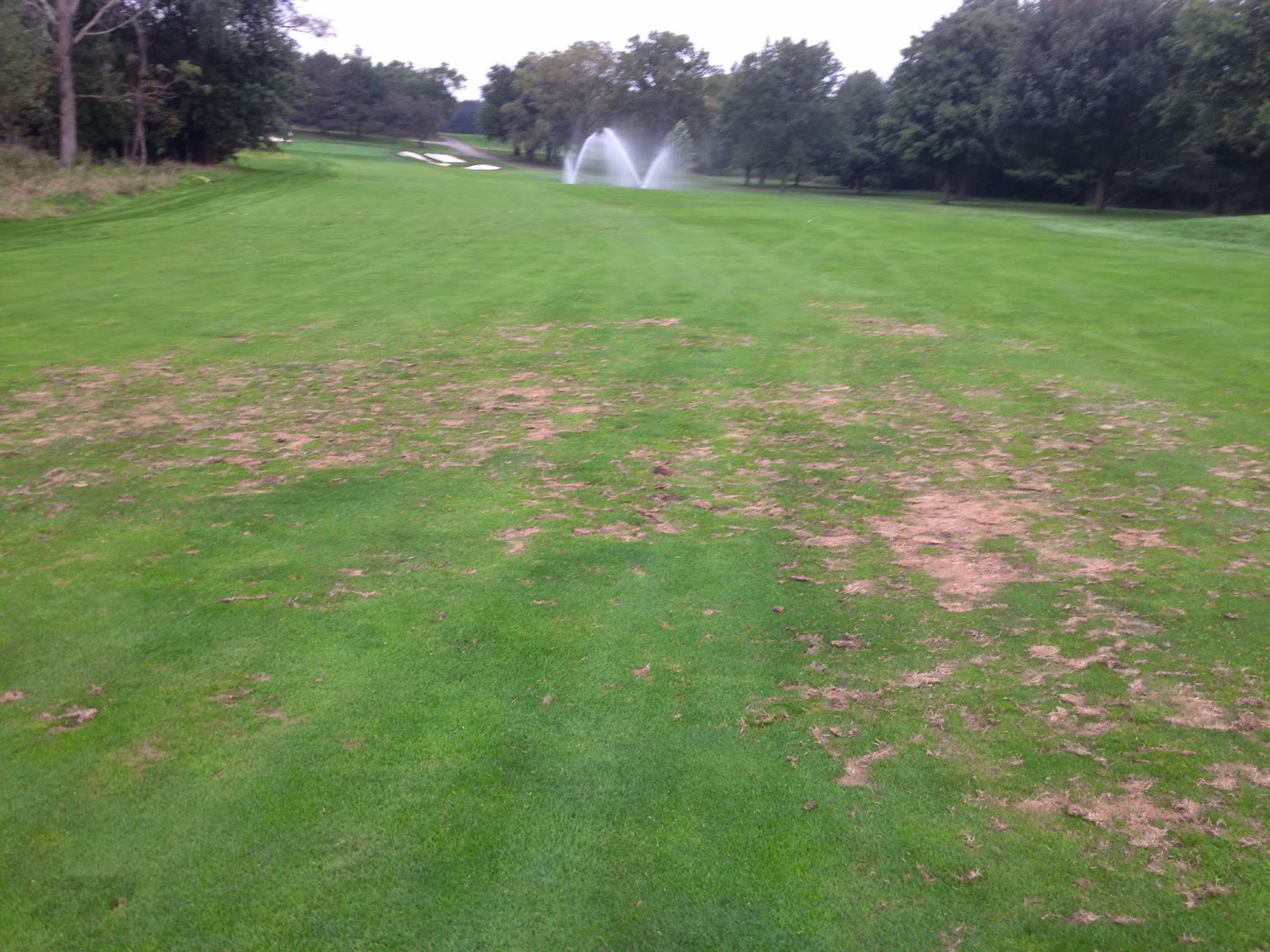
We've been battling some grubs this year, particularly #10 fairway as shown below.  We treat the entire golf course preventatively back at the end of June, however, we never really know how effective it is until the fall.  We did have some breakthrough this year, which may be attributed to the amount of rain we received this year.  We have been treating the grubs post emergent in these areas.  The damage has begun to subside and recovery is now evident.


Thursday, September 4, 2014

Green Issues and #7

There is a disease called Bipolaris leaf spot that is evident on a couple of the greens.  This disease may be the result of one of the wettest summers on record.  The greens have been treated and the CDGA has taken samples to confirm the diagnosis.  We have been proactive in the healing process and have already seeded/ plugged the infected areas.


How come the lake levels are so low? 

We’ve been lowering the lake level to prepare for the dredging of the waste bunker on #7.  We will be excavating the bunker and water will flow to the greenside.  This will make for a much more difficult approach shot!


Saturday, August 30, 2014

Aerification Schedule

September is the perfect time of year for aerification.  Aeration is critical to grow healthy grass and provide superior playing conditions during the stressful months of July and August.  In September the day lengths are shorter and nighttime temperatures are cool (50’s).  This environment allows a quick recovery (about 10 days) since the grass is still actively growing. 

Below is the schedule for our greens, tees, and fairways:

September 3rd- Holes 13-18 (Tees/Fairways)
September 9th- Holes 4-9 (Tees/Fairways)
September 11th- Holes 1-3, 10-12 (Tees/Fairways)
October 27th- Greens (1-18)

Why do we aerify?

Aerification provides the following primary benefits:

-Thatch reduction
-Air/water movement
-Compaction reduction

We will try to complete this work as quickly as possible.  If everything goes well, we may be able to complete the entire tee/fairway aeration in 2 days. 


Below is a link to a video that the USGA prepared on greens aeration and its benefits:


Friday, August 15, 2014

Project Updates

This past week we finished leveling and seeding the #7 and #16 Championship tees.  The sprinklers will be turning on automatically at 10:00 AM and 2:00 PM for the next couple of weeks to ensure proper germination. 


Questions have arisen about the areas next to #14 tee and behind #15 green.  We are in the first stage of a project to reseed this area to fescue.  These areas have been designated as “low maintenance” and we are seeding a mix called “Bandon Dunes.”  Weather permitting, seeding of these areas will begin next week.  The best time for any seeding is August 15th - September 15th.  This time is ideal because soil temperatures are high and nighttime air temperatures are low.


Saturday, August 2, 2014

Couple weeks in review!

As the length of daylight shortens, the maintenance crew begins their day later in the morning.  We currently start at 5 AM so that we don’t interrupt golf play on any of the holes.  Starting Monday, however, we will start at 5:30 AM due to morning darkness.  If you tee off before 7 AM you may meet up with our greens mower or set up person.


In the past couple of weeks we’ve been able to get more detail work done throughout the course.  We’ve begun the process of limbing up the pines on #13, 14, and 15.  The next trim area is the area to the right of #5. 


#14 Before


#14 After


You may have noticed the edging of sprinklers on the course.  


Click on the video below to see the head edger in action!


Finally, you may have seen one of our staff poking little holes on the greens with a device that looks like a pogo stick.  This is actually a new piece of equipment we purchased to measure soil moisture in the greens.  It provides information that allows us to water more efficiently, save water, and “dry” the greens out without worrying about wilt.

Reynaldo Ocampo (our foreman) checking the greens for soil moisture.


The output screen of our meter.  VMC% means volumetric water content percent.  The reading of 18.4 indicates that the soil moisture is adequate.  If the reading registers below 10, watering would be initiated, as wilt would set in during the afternoon hours.


Sunday, July 13, 2014

July 11, 2014 Scouting Report

Scouting Report
July 11, 2014 Scouting Report

A week of perfection almost was how we could describe this week. For those of you who had healthy turf starting the week - the end of the week should have been a great finish despite some rain. Blue skies and excellent temperatures really made for the best growing week we have had so far this year. Courses that were suffering from some of the heat and stress of the previous week began to clear up and return to excellent conditions in the Chicagoland area. Further south there were some stressful conditions early in the week but people are looking forward to next weeks summer version of the polar vortex as the early part of the week temperatures are predicted to drop back to highs in the 60's in Chicago while highs in Carbondale the highs are predicted to top out in the mid to upper 70's - glorious!

The British Open is next up for many of us to look at and the talk of brown is better will continue, however it is always easier to do this on sand based soils in weather conditions that are not humid and in temperatures that don't reach the 90 degree mark... EVER. For us particularly in the northern part of the state it is something to always keep in mind when thinking about new grass surfaces and long term sustainability of them. One summer doesn't make a lifetime of putting surfaces unfortunately. Further to that, there is a course rotation for the British Open and so these courses can take ten years off before the next Open which is why they can push their greens to extremes unlike daily play courses - it's not like we can open for one week of the year! Enjoy the viewing but remember links golf only makes up 5% of the golf courses across the pond!

Disease pressure has dissipated somewhat this week, though insect damage did start to show up as courses began to dry out. It seems that bluegrass billbug has made an appearance as a couple of locations failed the tug test. Further to that, adult Japanese beetles have shown up all over and the seedcorn beetle was also found towards the end of the week. Finally field day season has reached us, for the very latest in research results they are a great tool to help you make decisions for that early order program that is surely going to sitting on your desk soon.

Click here to view the July 11, 2014 Scouting Report

As always if you have a question or query please do not hesitate to ask and you can call or email.

Ed Nangle PhD
Director of Turfgrass Programs
Chicago District Golf Association
Office: (630) 685-2307
Cell: (630) 423-1925
www.cdgaturf.org
Follow us on Twitter @TurfResearch

Wednesday, July 9, 2014

What is that stuff?

The black areas that golfers are noticing on the greens are Silvery Thread Moss, Bryum argeneum.  Moss is generally attributed to low N fertility and over watering.  This moss growth began to emerge as a problem last year.  We are utilizing several different strategies to eradicate the moss.  Once the moss becomes established, it can be very difficult to control.  The products used to control moss can be tough on turf (especially greens).  Therefore, we must apply these chemicals at lower rates that result in a longer period to control the moss.   We should begin to see results in approximately a month.  The black color is actually good  (the areas were previously green).  The color change demonstrates that the strategies we have employed are beginning to kill the moss.  A combination of chemicals and cultural practices should eradicate this problem.